
So last weekend when I stayed with my boyfriend, we ended up going to some places that were new to me. In all honesty I was having a rough day pain wise and so this combined with unknown pavements meant that it was better for me to travel with my chair tilted. But having my chair tilted means that it is difficult and often impossible for me to see my front wheels, meaning I don’t know exactly where they are.
While traveling with him we came across many drop curb pavements with tactile markings, such as those pictured below. These are obviously intended to help those with visual impairments cross the road safely. It was then that I realised that these tactile markings also helped me to be able to feel where the pavement crossing is and therefore cross the pavement safely.
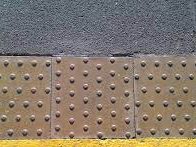
Despite traveling independently and using these types of crossings for many years, this only just occurred to me, and I honestly believe it is an important point to raise having just realised it in practice myself.
That is, that sometimes assistive things that are put in place to provide accessible to one group of people, can also provide help to another. And to me, this makes the assistive element more valuable as it can help more people.
While tactile pavement markings are one example I just realised, there is many examples of assistive technology helping more than its intended audience, or technology accidentally being assistive to those who need it. For example, automatic doors, would also be helpful for those with a lot of shopping or small children that they need to get through the door. Or straws which are a tool that makes drinking drinks easier for some, makes it possible at all for others. You get the idea, I hope.
Now another thing to note that is interesting here, is the reality that most non-disabled people would not view straws as an accessibility tool. It seems to me that once an accessibility tool is recognised by non-disabled people as being useful, it is no longer viewed as an accessibility tool.
What I’m really saying, is that the more accessible the world becomes more accessible to disabled people, and that an accessible world is more helpful to all people than you might realise. Perhaps the washing machine used to be seen as an accessibility tool, for those who couldn’t do there washing by hand, but now the use of a washing machine and a dryer has become standard practice to a lot of people in the world. And I am sure a lot of people see the world as easier for them due to the invention of the washing machine and dryer.
One day accessibility will not be a taboo word, I hope. One day, the most accessible way of doing things, will become the normal way of doing things.
But then I suppose this leads us to another problem, that is that accessibility is different for everyone. So, will we ever reach a point where the standard way of doing things is a way that is completely accessible to everyone? In all honesty I don’t think so. But that doesn’t mean that we shouldn’t try to make the world as accessible as we possibly can to as many people as possible. Surely, we should try to have the most accessible world to everyone.
 My Inaccessible Life